

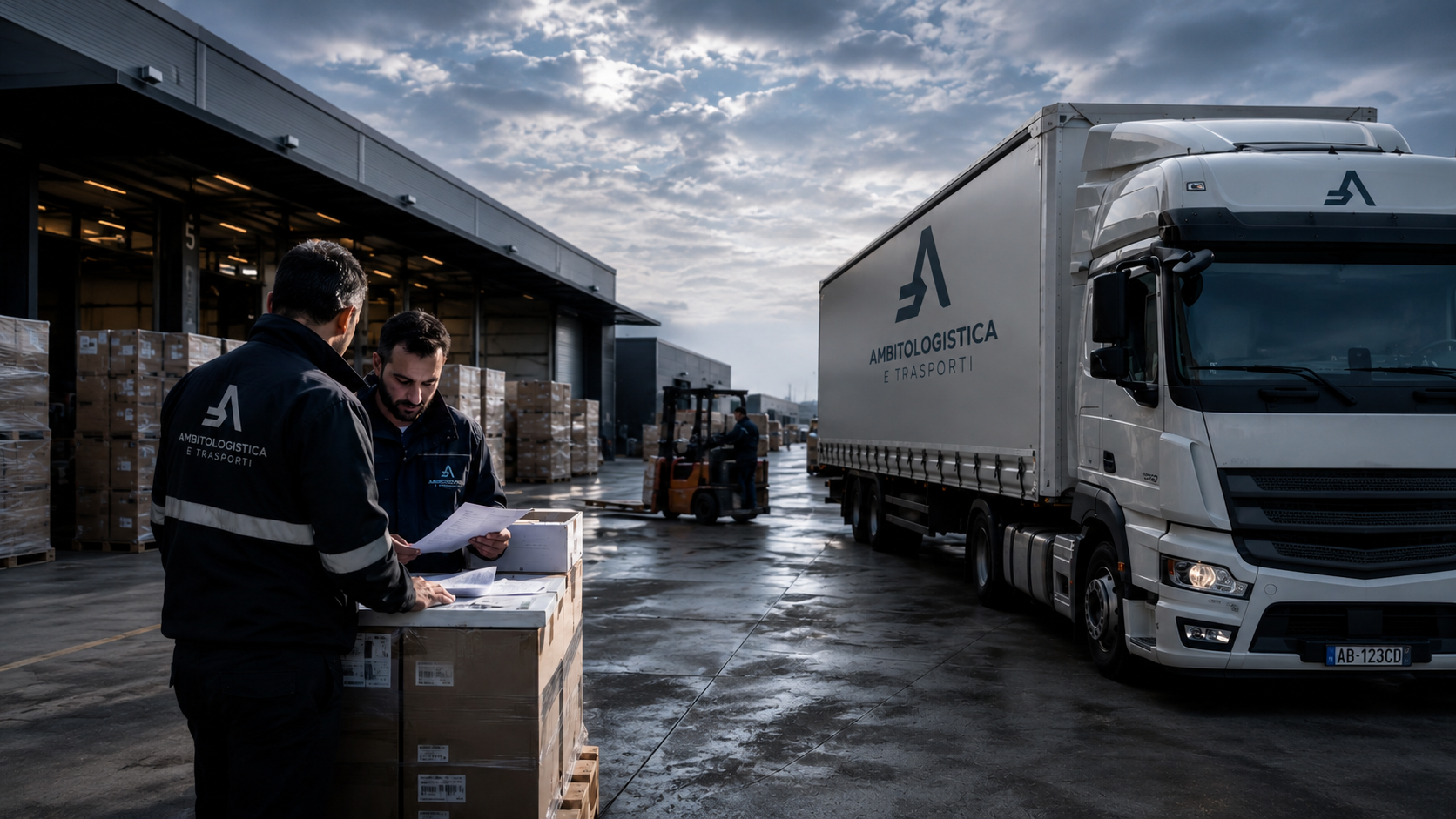
Luca has run the shipping office of a transport company for twelve years.
His TMS is up to date, and his company has invested wisely: delivery tracking, dashboards on vehicle load, KPIs on everything. On paper, a modern logistics company.
But at 8:30 every morning, the same pile is on his desk: CMRs that arrived overnight from carriers, some written by hand and photographed with a phone by a driver on the motorway.
Delivery notes (DDTs) with a different supplier's layout every time.
And then the proofs of delivery — the PODs — the ones that really matter, because until that document is in the system, the invoice can't go out.
Luca knows that every CMR misread, every quantity transcribed wrongly, can stop a load at customs or trigger a dispute with the customer the following month.
He also knows that every day of delay in entering a POD is a day of payment pushed back.
And yet he still spends hours every day doing exactly this: reading, checking, retyping. Not because his company hasn't digitized.
But because none of the tools tried so far has truly closed the loop between the paper document and the TMS.
This is the typical scene for anyone working in logistics and transport today. And it is also the exact point where an Intelligent Document Processing (IDP) solution built for this sector makes the difference between continuing to pay that cost every day — and stopping paying it altogether.
The problem nobody budgets for
In logistics, the document is the operational flow, not an accessory.
Transport orders, CMRs, delivery notes, customs documents, bills of lading and proofs of delivery arrive every day from dozens of different carriers and customers, in different formats, often handwritten on a trailer, in a yard, in the rain.
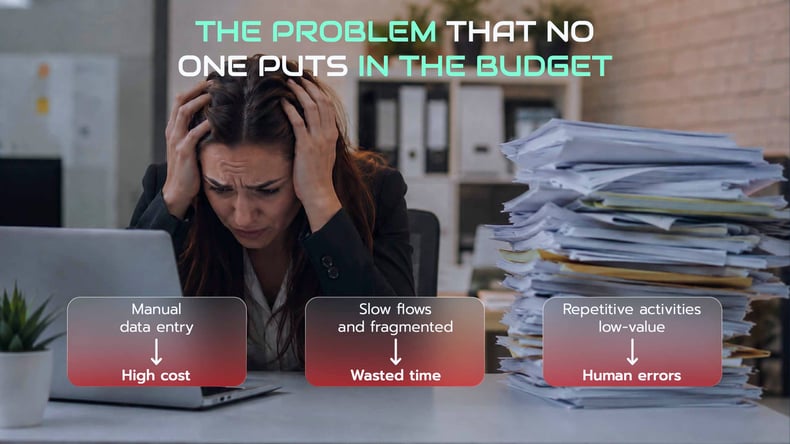
Nobody in the company has a budget line for "time spent retyping CMRs into the TMS". But the cost exists, and it is measurable:
- 3–10 minutes per document for reading, checking and manual entry
- €2–5 processing cost per document
- 7–10% error rate in manual data entry
And in logistics, unlike other sectors, an error doesn't stay confined to an Excel sheet: a wrong data point on a CMR can block a shipment, a POD entered late delays invoicing by days, a wrong destination code generates penalties and disputes with the customer.
Three critical points, in particular, recur in almost every transport company:
- CMRs and delivery notes retyped by hand. A different layout for every carrier, fields written in pen, different languages for international transport. Every document means manual entry and double-checking in the TMS.
- PODs that slow down invoicing. The proof of delivery is the key to issuing the invoice. If it gets into the system late, payment slips and cash flow is held hostage by data entry.
- Errors that become disputes. A quantity on the CMR that differs from the order, a wrong destination code: it takes very little for an entry error to turn into a dispute with the customer or a customs delay.
The solutions the market has already tried — and where they fell short
Anyone who has worked in logistics for years has almost always already tried to solve this problem. And it's worth being honest about what worked and what didn't.
Classic OCR helped with standard printed documents, but it is almost useless on a CMR written by hand or photographed with a smartphone: accuracy collapses, and the result is still raw text, not data ready for the TMS.
Template-based systems worked as long as the document format stayed stable. But all it takes is a carrier changing the layout of its CMR, or a new customer with a format never seen before, to require a new configuration — weeks of work each time, multiplied across dozens of different suppliers.
AI-based extraction tools (Microsoft AI Builder, Nanonets, Rossum, among others) represent a real leap: they read unstructured documents, without rigid templates. But almost all of them stop right there, at extraction. They return the data they have read — and then:
- smart matching against customer master data and destination codes is left up to you
- the rules on what to do when a CMR doesn't match the order have to be built from scratch
- the actual entry into the TMS or WMS still requires a custom integration, often entrusted to a system integrator
The "we'll build it with a system integrator" route is feasible, but rarely as cheap as it looks on paper: on average 6–12 months of project work, an integration to maintain at every process change, and total costs that can be 5–10 times higher than a software license designed to do this natively.
The practical result, in all these cases: the document is read better, but the data doesn't get into the TMS on its own. Data entry hasn't been eliminated. It has been moved further down the process.
RIV4 completes exactly what the others leave half-done
RIV4 is built specifically to close this gap: not just another extraction tool, but a platform that carries the data from the transport document all the way into the TMS, the WMS or the ERP, with no residual human intervention.
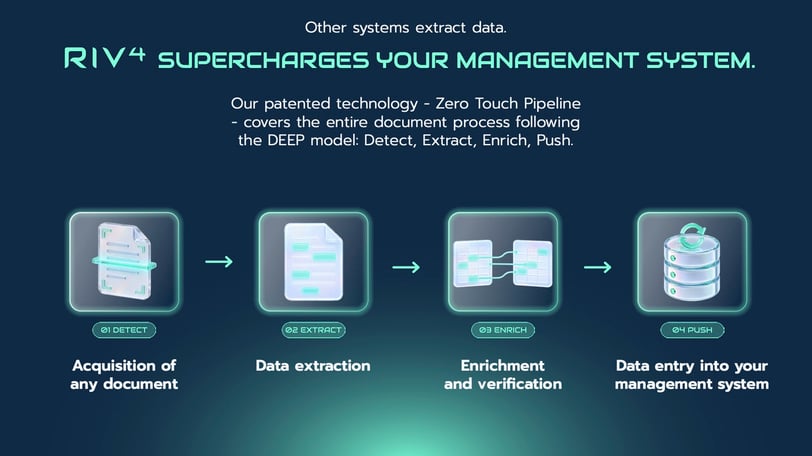
The mechanism is the Zero-Touch Document Pipeline, which is patented and follows the DEEP model applied to the logistics process:
- Detect — RIV4 captures transport orders, CMRs, delivery notes, PODs and customs documents from any channel (email, EDI, FTP, carrier portal, scanner, API) and in any format: PDF, scans, images, XML, digitally signed files. No preliminary configuration, no channel excluded.
- Extract — the AI extracts data regardless of layout: handwritten CMRs, delivery notes from hundreds of different senders, international bills of lading. No templates, no training. It is configured in natural language: describe what you want to extract, and RIV4 does it.
- Enrich — this is where something happens that no competitor does natively. RIV4 enriches the data with smart matching against customer master data, destination codes and order references, and applies the company's operating rules directly in the workflow: for example, "if the quantity on the CMR doesn't match the order, open a flag" — before the error becomes a dispute.
- Push — validated data is sent directly to TMS, WMS and ERP via real-time API or standard files (JSON, XML, CSV). The shipment is tracked, and the POD is ready for invoicing the same day.
For Luca, in practice: the CMR arrives, is read, is validated against customer master data and is entered into the TMS — without anyone having to open it manually anymore.
Why RIV4 is the right choice for a transport company
RIV4 is designed for those in logistics who process high document volumes in processes that can't afford delays:
- Zero training, zero templates — operational in days, even with dozens of carriers and formats to manage at the same time
- Embedded business rules — mismatches between CMR and order are caught in the workflow, not discovered afterwards, when the load has already left
- Lowest TCO in the category — in the Speed of adoption vs Total cost matrix, RIV4 occupies a quadrant where no other player on the market is present
- It integrates with what you already have — TMS, WMS, ERP: no need to change your existing management systems
RIV4 for logistics is the right solution if:
- Every day you process high volumes of CMRs, delivery notes, PODs, transport orders or customs documents
- You already have a TMS or a WMS and want the data from your documents to get there automatically
- Late PODs slow down your invoicing and your cash flow
- You handle documents from dozens of carriers and customers in heterogeneous formats
- You have already tried other IDP tools and still ended up with residual data entry
It is not the right priority, however, if you process fewer than 500 documents a month, or if the need is simply to archive documents without automating the flow into the management system.
The results and the companies that have already chosen it
RIV4 is not a theoretical platform: it is already operational, with measurable results in production on real logistics processes.
- −80% processing time for transport documents compared with the manual process
- Less than 1% error rate, versus 7–10% for manual data entry
- 10 million+ documents processed every year on the platform
- Operational in days, not months — no templates, no training
- Lowest TCO in the category, in the Speed vs TCO quadrant where no other player is present
Among the transport and logistics companies that have already chosen RIV4: STEF, Trans Italia, Broad Log, Meditrans, S&L Trasporti, Drivalia.
The principle guiding these companies is simple: the document is no longer the end point of the shipment, but the starting point of a flow that ends only when the data is in the TMS, ready to invoice.
Recognition also comes from outside the direct market: Velion, the company that developed RIV4, was included by Fondazione Italia USA among the 300 best startups of 2025, and is a finalist at the Document Manager Awards 2025 in two categories — Data Capture/Recognition and Product of the Year.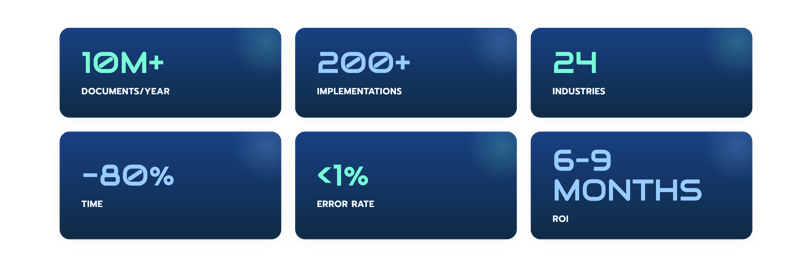
The next step
It takes just 30 minutes to see RIV4 working on your real transport documents — not on a generic demo, but on CMRs, delivery notes or PODs from your own process, with your master data and your TMS.
After that session you'll know exactly what RIV4 is worth to your company: in hours saved, errors eliminated, and invoicing days recovered.
Book a RIV4 demo for logistics and find out how much you can speed up your invoicing cycle starting with your very next load.