


Chiara runs the purchasing department of a large-scale retail (GDO) chain.
Her retail management system is up to date, category management works well, and sales reports by department arrive on time every morning.
Yet every week, the same pile of supplier price lists lands on her desk — dozens of different formats, PDF and Excel, each with its own structure — to be reconciled by hand with the item master data before the new prices go into the system.
Chiara knows full well what happens when something slips through: a wrongly entered price doesn't stay an isolated error, it multiplies across thousands of items.
A promotion loaded late is not an administrative nuisance, it is a lost sale for the entire week of the campaign.
And yet, despite the investments made in category management systems, the entry point of all this data — the price list, the promo, the invoice — is still left to manual entry, field by field.
This is the typical scene for anyone working in purchasing or supplier management in grocery retail today.
And it is also the exact point where an Intelligent Document Processing (IDP) solution built for this sector makes the difference between chasing pricing errors and protecting margin at the source.
Margin is decided on the price list, not on the shelf
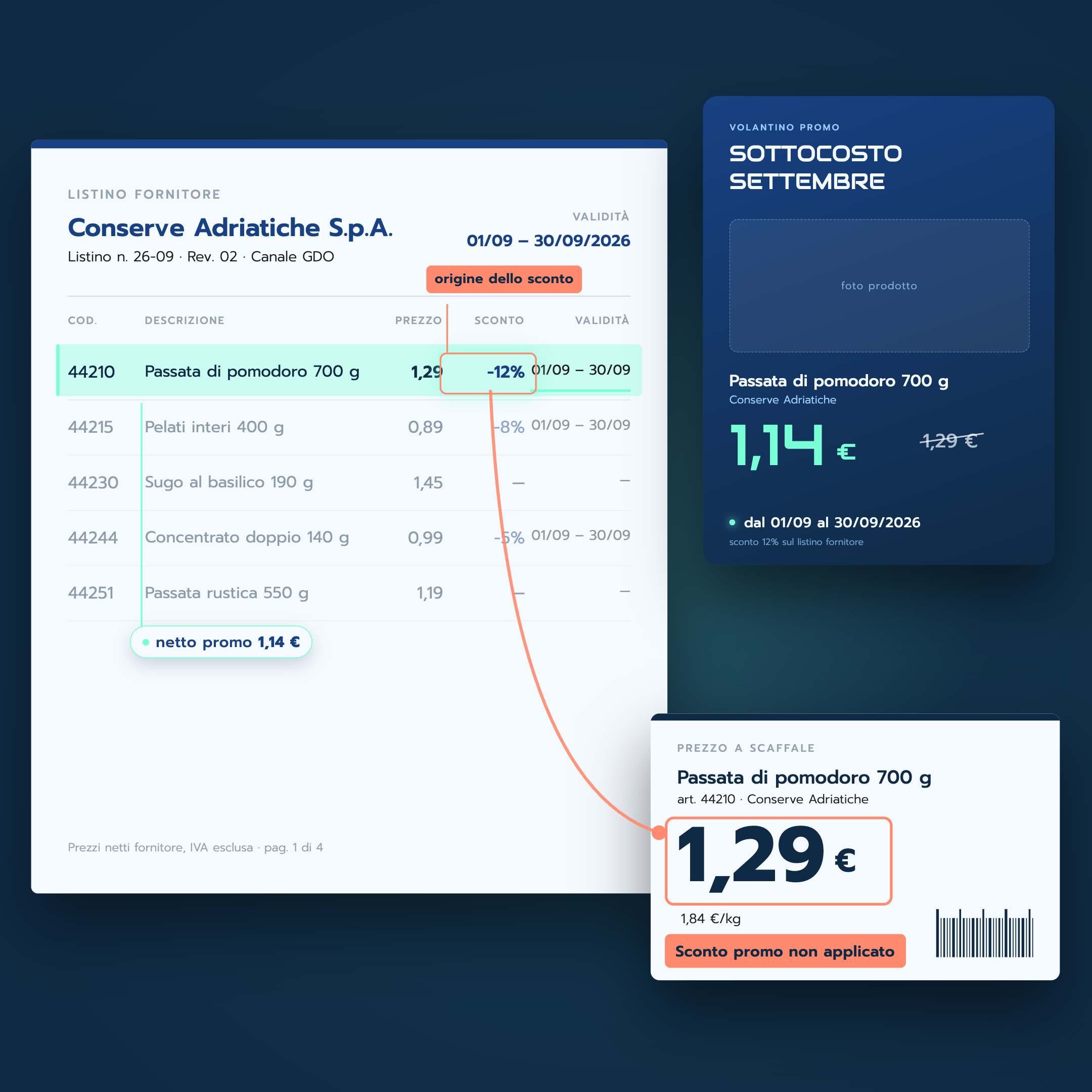
In grocery retail, documents are high-volume and high-variety by nature: every supplier sends price lists in a different format, promotions change every week, and items approaching expiry must be monitored by product category. Nobody in the company has a budget line for "time spent reconciling price lists by hand". But the cost exists, and it is measurable:
- 3–10 minutes per document for reading, checking and manual entry
- €2–5 processing cost per document
- 7–10% error rate in manual entry
And in retail, an error doesn't stay confined to a spreadsheet: a wrong price in the system erodes margin on thousands of items at once, while a promotion loaded late is a lost sale for the entire duration of the campaign.
Three situations, in particular, repeat themselves in almost every retail chain:
- Multi-format supplier price lists. Every supplier has its own layout: prices, terms and codes to be manually reconciled with the item master data, week after week.
- Constantly changing promotions. Flyers, promotional agreements, different mechanics per category: slow or wrong entry and the promo starts wrong — or doesn't start at all.
- Invoices, statements, expiry dates. Supplier invoices to be matched, account statements to be reconciled, expiring items to be monitored: volumes that manual data entry simply cannot scale to.
The solutions tried so far — and where they fell short
Anyone who has worked in grocery retail purchasing for years has almost always already tried to solve this problem, with partial results.
Classic OCR worked on documents printed in a standard way, but collapses on multi-format price lists or foreign invoices: the result is still raw text, which has to be interpreted manually before it can be used.
Template-based systems held up as long as the price list format stayed stable. But all it takes is a supplier updating the look of its price list, or a new supplier with a format never seen before, to require a new configuration — weeks of work, multiplied across dozens of different suppliers.
AI-based extraction tools (Microsoft AI Builder, Nanonets among others) represent a real leap in document reading. But almost all of them stop at extraction: they return prices and codes read from the price list, and then smart matching with the item master data, minimum margin rules and entry into the retail management system are left to the company or to a system integrator.
The "we'll build it with a system integrator" route remains viable, but is rarely as cheap as it seems: on average 6–12 months of project work, with total costs that can exceed by 5–10 times those of a license designed to do this natively.
The practical result: the price list is read better, but the price doesn't get into the retail management system on its own, correct and validated. Data entry hasn't been eliminated. It has been moved.
RIV4 completes exactly what the others leave half-done
RIV4 is built to close this gap: not just another extraction tool, but a platform that carries data from the supplier price list all the way into the retail management system, with category rules already applied.
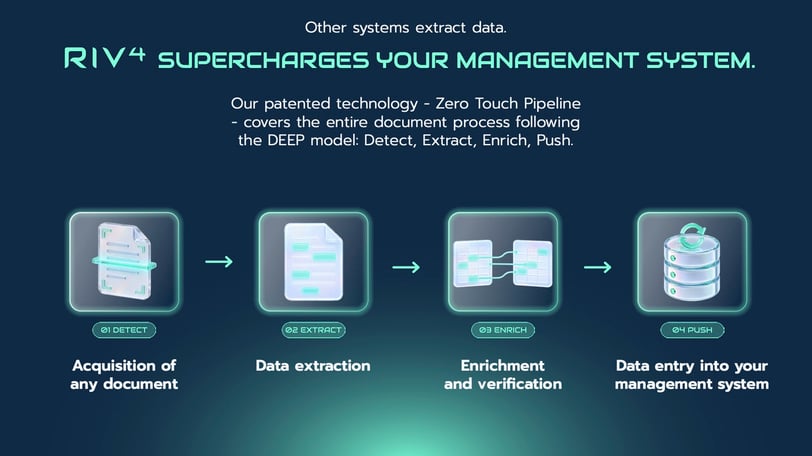
The mechanism is the patented Zero-Touch Document Pipeline, which follows the DEEP model applied to the retail process:
- Detect — RIV4 captures price lists, orders, promotions, invoices and account statements from any channel (email, EDI, supplier portal, API) and in any format: PDF, Excel, XML, scans. No preliminary configuration, no channel left out.
- Extract — the AI extracts prices, terms and codes regardless of the supplier's format: hundreds of different price lists, every week. No templates, no training. Configuration in natural language.
- Enrich — this is where something happens that no competitor does natively. RIV4 enriches the data with smart matching against item and supplier master data, and applies rules by product category directly in the workflow: prices, minimum margins and promotional mechanics are checked before entry into the system.
- Push — validated data is sent directly to the retail management system and the ERP via real-time API or standard files. Price list updated, promo ready, margin protected.
For Chiara, this means the price list arrives already read, reconciled with the item master data and checked against minimum margin rules — before an anomalous price can even enter the system.
Why RIV4 is the right choice for a retail chain
RIV4 for retail is the right solution if:
- You handle high monthly volumes of price lists, promos, orders and invoices
- Your suppliers send documents in dozens of different formats
- Pricing errors in the system erode your margin on many items
- You have a retail management system or an ERP and want data to reach it automatically
- You need business rules by category, not simple "flat" extraction
It is not the right priority, however, if you process fewer than 500 documents per month, or if the need is only to archive documents without automating the flow into the management system.
The results and the companies that have already chosen it
- −80% in time for price list and promo updates compared to the manual process
- Less than 1% error rate on prices and master data, versus 7–10% manual
- 10 million+ documents processed every year on the platform
- Operational in days, not months — no templates, no training
- Lowest TCO in the category, in the Speed vs TCO quadrant where no other player is present
Among the distribution and retail companies that have already chosen RIV4: CRAI, Crai Energy, Ingros Carta Giustacchini.
The principle guiding these companies is simple: RIV4 manages everything centrally, with business rules specific to each product category or supplier, whatever the format of the incoming document.
Recognition also comes from outside the direct market: Velion, the company that developed RIV4, was included by Fondazione Italia USA among the 300 best startups of 2025, and is a finalist at the Document Manager Awards 2025 in two categories — Data Capture/Recognition and Product of the Year.
The next step
All it takes is 30 minutes to see RIV4 working on your real price lists and promos — not on a generic demo, but on your supplier formats, your item master data and your retail management system.
Book a RIV4 demo for large-scale retail and find out how much margin you can protect starting from your next price list update.